
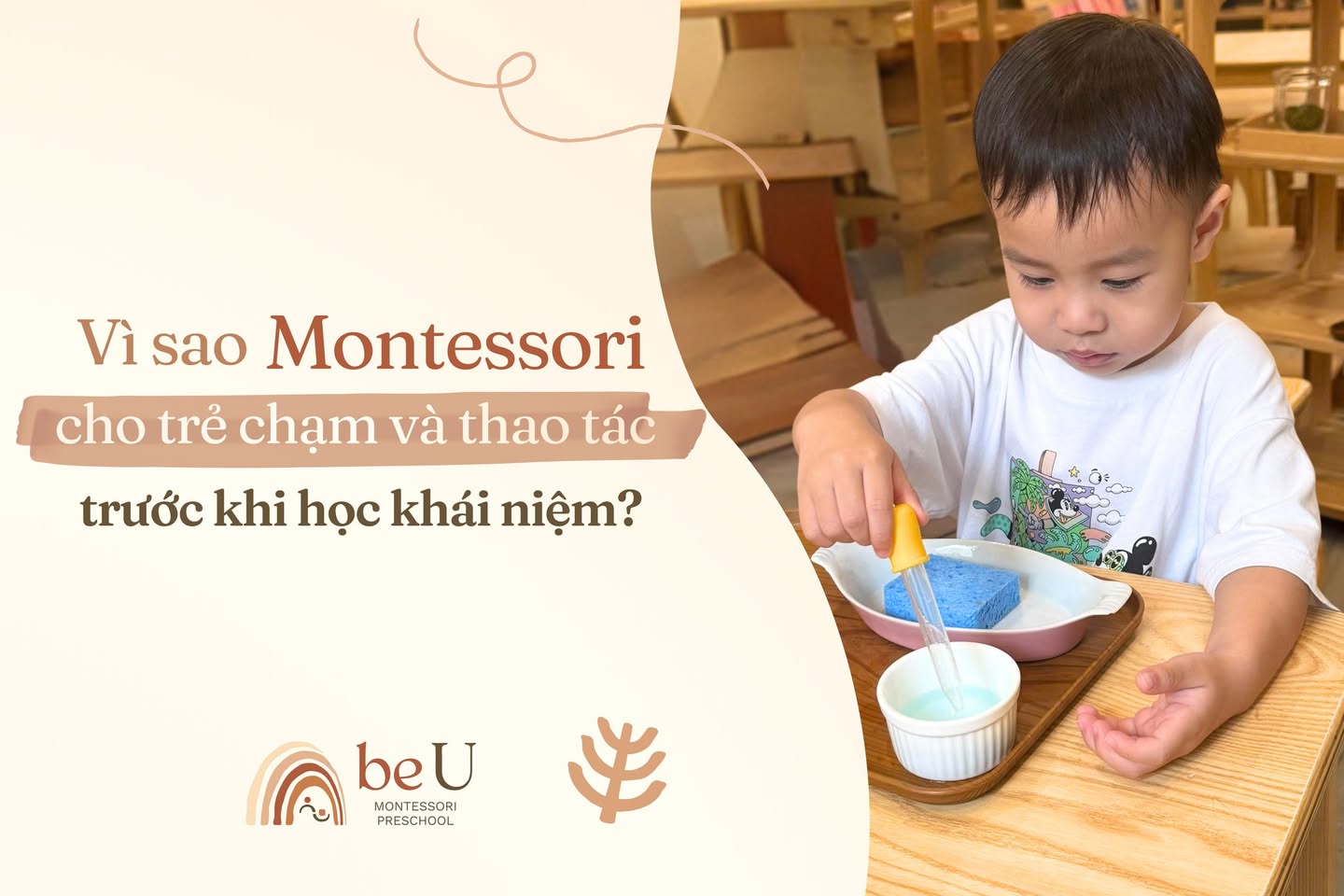
Trong những năm đầu đời, trẻ chưa thể tiếp nhận thế giới bằng những lời giải thích. Con hiểu thế giới bằng đôi tay, đôi mắt, đôi tai và bằng chính những gì mình được trực tiếp trải nghiệm.
Đó cũng là lý do trong Montessori, trải nghiệm cụ thể thường đi trước khái niệm trừu tượng.
Khi một em bé cầm, di chuyển, so sánh hay lặp lại một thao tác với giáo cụ, con không chỉ đang chơi. Đôi tay đang gửi thông tin về não bộ: vật này nặng hay nhẹ, dài hay ngắn, nhiều hay ít, giống hay khác nhau. Từ những cảm nhận rất cụ thể ấy, trẻ dần hình thành khả năng phân loại, so sánh, ghi nhớ và nhận ra mối quan hệ giữa các sự vật.
Trước khi thực sự hiểu khái niệm về số lượng, trẻ có thể đã nhiều lần tự tay đặt từng hạt vào vị trí tương ứng. Trước khi gọi tên một hình học, con đã được cầm, xoay, cảm nhận đường viền và nhận ra sự khác biệt giữa các hình bằng chính đôi tay của mình.
Montessori không vội đưa cho trẻ câu trả lời. Môi trường được chuẩn bị để con có cơ hội tự mình trải nghiệm, thử lại, nhận ra sai khác và từng bước đi đến sự hiểu biết của riêng mình.
Vì thế, có những lúc ba mẹ nhìn thấy một em bé đang làm một việc rất đơn giản, nhưng bên trong sự đơn giản ấy là cả một quá trình xây dựng trí tuệ. Con đang đi từ cái mình có thể chạm vào, đến điều mình có thể hiểu, rồi dần đến điều mình có thể tư duy.
 Tại beU, chúng mình trân trọng những đôi tay nhỏ đang miệt mài khám phá mỗi ngày. Bởi trước khi một đứa trẻ có thể nói rằng “con hiểu rồi”, có lẽ con cần được chạm vào thế giới đủ lâu để tự mình hiểu nó.
 Mời ba mẹ ghé thăm một buổi School Tour tại beU để trực tiếp quan sát cách những trải nghiệm rất nhỏ trong lớp học đang từng ngày nuôi dưỡng tư duy của con.
────୨ৎ────
 Why does Montessori encourage children to touch and manipulate before learning concepts?
In their early years, children cannot yet absorb the world through explanations. They understand the world through their hands, eyes, ears, and their own direct experiences.
That is also why in Montessori, concrete experiences often precede abstract concepts.
When a child holds, moves, compares, or repeats an action with learning materials, they are not just playing. Their hands are sending information to the brain: whether an object is heavy or light, long or short, more or less, similar or different. From these highly specific sensations, children gradually develop the ability to categorize, compare, remember, and recognize relationships between objects.
Before truly understanding the concept of quantity, a child may have already placed individual beads into their corresponding positions many times by hand. Before naming a geometric shape, they have already held, rotated, felt its outlines, and recognized the differences between shapes with their very own hands.
Montessori does not rush to give children the answers. The environment is prepared so that children have the opportunity to experience things for themselves, try again, recognize their own mistakes, and step by step reach their own understanding.
Therefore, there are times when parents see a child doing something very simple, but within that simplicity lies a profound process of intellectual development. The child is progressing from what they can touch, to what they can understand, and gradually to what they can critically think about.
At beU, we cherish those little hands that are diligently exploring every day. Because before a child can say “I understand,” they likely need to touch the world long enough to make sense of it themselves.
We invite parents to join a School Tour at beU to directly observe how the smallest experiences in our classrooms are nurturing your child’s cognitive development every single day.

