
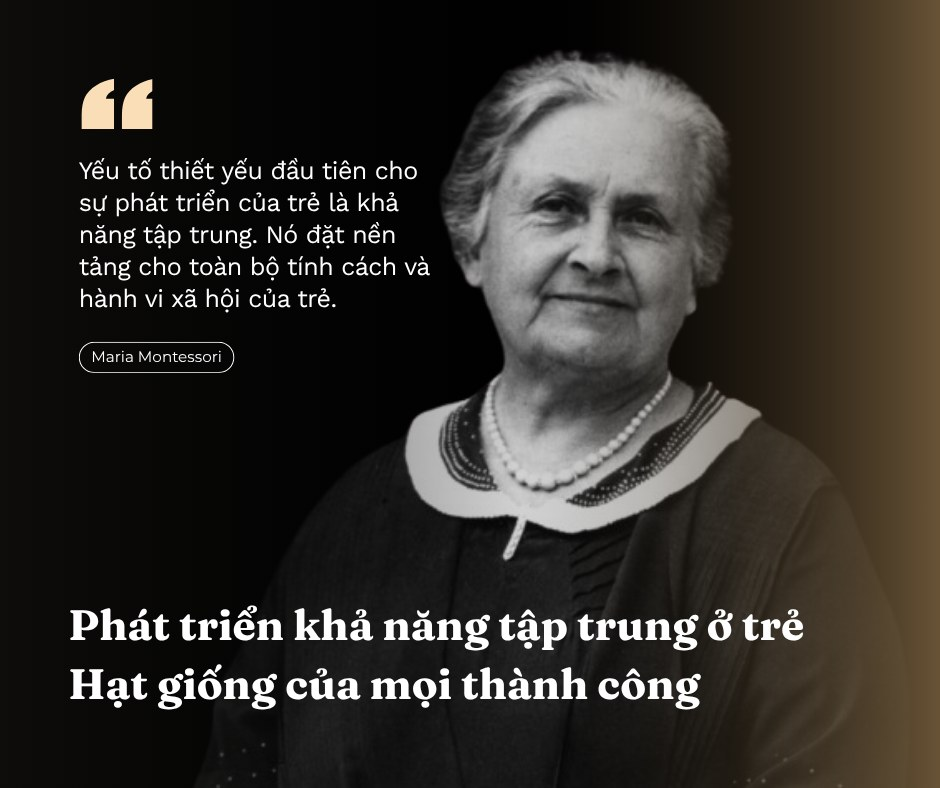
According to expert Paula Lillard Preschlack (Montessori Foundation), concentration is a foundational capacity that determines a child’s intellectual development, character, and social behavior. As early as the 1900s, Maria Montessori observed and affirmed that only when a child is truly concentrated—meaning deeply engaged in an activity that meets their inner developmental needs—does learning become meaningful and lasting.
🌿 In a Montessori environment, concentration is not forced; it is the natural result of three core elements:
• A carefully prepared environment—calm, aesthetically pleasing, allowing children to work independently and repeat activities.
• Long, uninterrupted work periods (around 3 hours)—enabling children to enter a state of “learning flow.”
• Scientifically designed materials—naturally engaging, supporting refined discrimination and self-organized thinking.
Montessori emphasized that adults cannot teach children how to concentrate. Instead, they must observe and recognize what captures a child’s attention, because that is the “gateway” to inner development. When children work in a suitable environment, they develop not only skills, but also willpower, self-regulation, emotional control, and compassion.
🔍 Modern neuroscience research (Jeffrey Schwartz, Sharon Begley, Daniel Goleman, among others) has confirmed what Montessori long ago stated: the brain develops and reorganizes itself only when a person concentrates with intention. Conscious attention is the condition for forming new neural connections—the foundation of lifelong learning.
🏡 For parents, Paula recommends protecting a child’s space for concentration by reducing interruptions, limiting screen time, and being fully present when with their child. With a peaceful environment, a slower rhythm of life, and moments of genuine connection, children naturally cultivate concentration—and a deep love for exploring the world.
“The first essential for the child’s development is concentration. It lays the whole foundation for his character and social behavior.”
— Maria Montessori, The Absorbent Mind (1967)
— Shared by the Montessori Foundation —
🌼 At beU Montessori – Là Em, all learning and daily activities are designed around this principle. Children are free to choose their work, repeat it until mastery, and are respected in their individual developmental rhythms—so that each day at school becomes a journey of focus, discovery, and growth.
💚 For us, “beU – Là Em” is not just a name, but a philosophy:
Respecting individuality – Nurturing concentration – Unlocking the inner potential of every child.
👉 Learn more about the learning journey at beU: https://www.facebook.com/beu.montessori
Trẻ là trung tâm của quá trình học
Trong lớp học Montessori, trẻ không “nghe giảng” – mà tự học thông qua trải nghiệm. Mỗi đứa trẻ được tôn trọng nhịp phát triển riêng, được tự do lựa chọn hoạt động và tự chịu trách nhiệm với quyết định của mình.
Giáo viên là người đồng hành – không phải người dạy
Giáo viên Montessori được gọi là “người hướng dẫn” (Guide) – người giữ không gian, quan sát và gợi mở đúng lúc, giúp trẻ phát triển từ bên trong thay vì áp đặt từ bên ngoài.
Môi trường học tập được “chuẩn bị có chủ đích”
Mọi vật dụng, giáo cụ, ánh sáng, màu sắc… đều được thiết kế khoa học để khơi gợi sự tập trung, tính thẩm mỹ và niềm vui học hỏi tự nhiên. Không gian Montessori là “người thầy thầm lặng”, giúp trẻ học cách sống có trật tự, kỷ luật và tự tin.
Tự do trong khuôn khổ – kỷ luật đến từ nội tâm
Trẻ được tự do lựa chọn, nhưng trong một môi trường rõ ràng, có giới hạn. Chính sự tự do ấy giúp trẻ hình thành kỷ luật nội tâm – biết tôn trọng bản thân, người khác và cộng đồng.
Montessori không dạy trẻ trở thành ai đó, mà giúp trẻ trở về đúng với bản thể của mình – độc lập, tự tin và hạnh phúc.
Tại beU – Là Em, chúng tôi không “sao chép” Montessori, mà sống cùng tinh thần Montessori mỗi ngày – trong cách thiết kế không gian, cách lắng nghe trẻ và cách nuôi dưỡng tuổi thơ an yên.

